Trusted by 200,000+ American Anglers — Real Reviews, Real Water, Real Results
FishingGears.org
Saltwater Guide2026 UpdatedDU Tech Tested

Sharp, Strong, and Salt-Ready: The Best Saltwater Fishing Hooks.

The ocean is a brutal environment. If your hooks aren't built for it, the salt will eat them before the fish even bites. We've tested the top-rated hooks on the market to see which ones stay sharp after a week in the surf — and which ones snap under the weight of a Florida Snook.

The DU Tech Team|Last Updated: April 2026|Florida Keys · Gulf Coast · California Surf
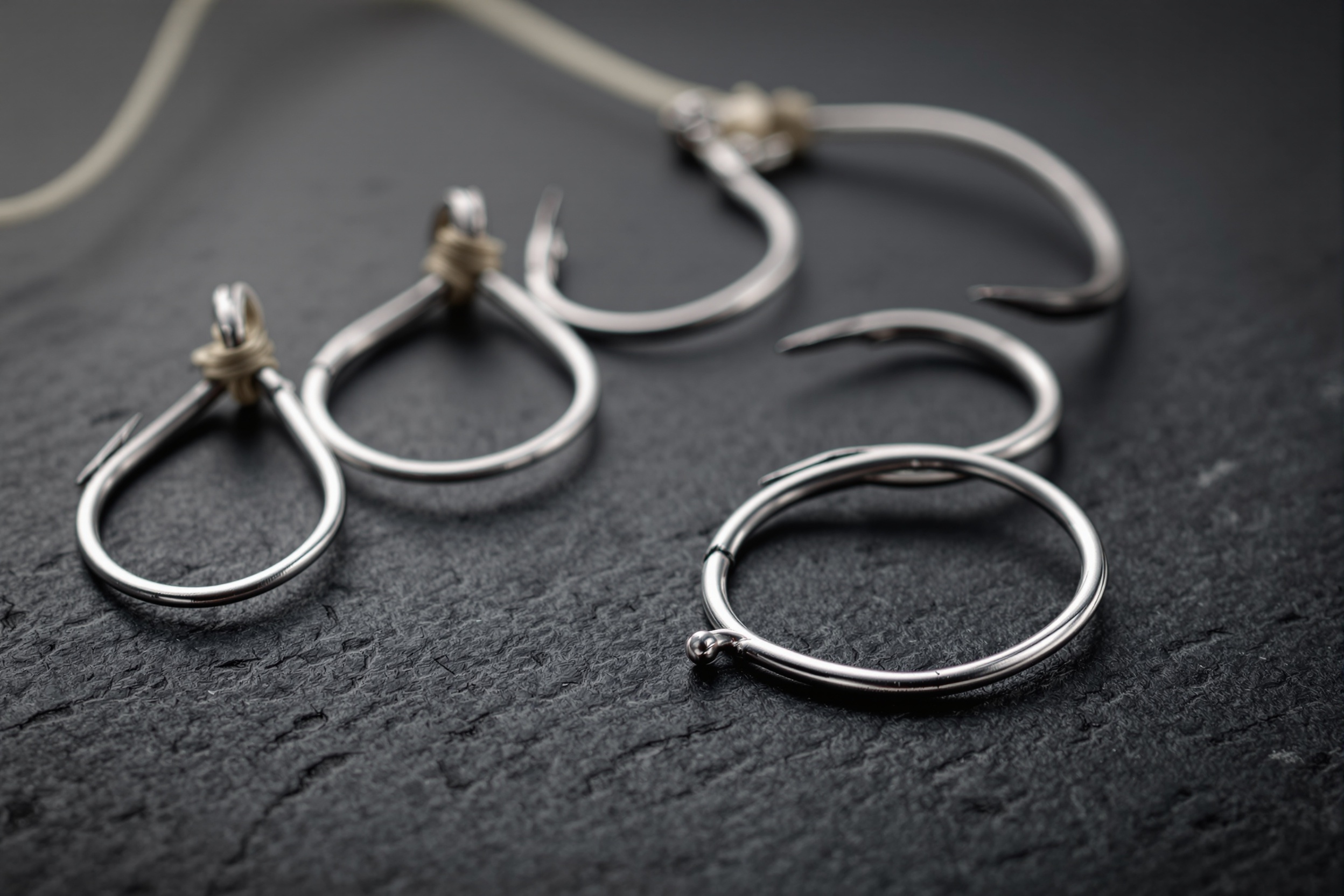
Close up of stainless steel circle hook for saltwater fishing
Rust Test Result
High-Carbon Steel Wins
The Right Tool for the Job

Hook Types Explained

Different saltwater species require different hook designs. Using the wrong type costs you fish. Here's exactly which hook to reach for — and why.

Close up of Circle Hooks for saltwater fishing
The Conservation King

Circle Hooks

Best For

Catch & release, reef fishing, live baiting for Snook, Redfish, and Tarpon

Designed to hook the fish in the corner of the mouth, preventing 'gut hooking.' Saltwater species like Tarpon and Snook hit hard — circle hooks handle the pressure and keep the fish alive for a clean release. In Florida waters, these are the law for reef species.

Material
High-carbon steel with Duratin or black nickel finish
Common Sizes
1/0, 2/0, 3/0, 4/0, 5/0, 6/0
DU Tech Team Rust Test Note

We've used circle hooks for Snook fishing in the Florida Keys for years. The key: don't strike — just reel up the slack and let the hook do its job. It self-sets perfectly every time.

View on Amazon
Best for Surf Fishing: Size 4/0–6/0 with fresh shrimp or cut mullet on the Gulf Coast
Close up of J-Hooks for saltwater fishing
The Classic All-Rounder

J-Hooks

Best For

Trolling, live baiting, bottom fishing for Flounder, Pompano, and Sea Bass

Versatile and easy to hide in a baitfish. When you need an active hook set — driving the point home on the strike — J-hooks are the pro's choice for trolling offshore or working a live well. They work in every depth and every current.

Material
Stainless steel or high-carbon with black nickel coat
Common Sizes
1, 1/0, 2/0, 3/0, 4/0, 5/0
DU Tech Team Rust Test Note

For live baiting Kingfish off the Gulf Coast, we thread a J-hook through the nostril of a live Pilchard. The fish swims naturally, and the hook set is instant when a King strikes.

View on Amazon
Best for Surf Fishing: Size 2/0–4/0 rigged with a live Pinfish or cut bait on Florida beaches
Close up of Treble Hooks for saltwater fishing
For Lures & Plugs

Treble Hooks

Best For

Replacing rusted factory hooks on saltwater lures, topwater plugs, and spoons

Three points of contact for aggressive strikes. When a Jack Crevalle or Bluefish slashes at a topwater plug, one of those three points will connect. Replace cheap factory trebles with quality VMC or Owner saltwater-grade versions immediately — factory hooks rust within 2 trips.

Material
High-carbon steel, tin or black nickel finish — avoid cheap chrome
Common Sizes
#4, #2, #1, 1/0, 2/0
DU Tech Team Rust Test Note

After every saltwater trip, we rinse our lures and swap any treble that shows the first sign of orange rust. A $1 hook replacement beats losing a $25 lure — and more importantly, it beats losing a fish you've fought for 10 minutes.

View on Amazon
Best for Surf Fishing: Size 1–2/0 on popping corks or topwater lures for Speckled Trout
Close up of Octopus Hooks for saltwater fishing
The Live Bait Specialist

Octopus Hooks

Best For

Rigging shrimp, crab, and soft bait for Redfish, Sheepshead, and Flounder

The short-shank, wide-gap design of an octopus hook keeps live shrimp or crab alive longer — the bait can breathe and move naturally, which is the entire point when targeting picky Sheepshead or wary Flounder in shallow flats.

Material
Chemically sharpened high-carbon steel, red or black finish
Common Sizes
#2, #1, 1/0, 2/0, 3/0
DU Tech Team Rust Test Note

In California's surf zone, we pin live sand crabs on 2/0 octopus hooks for Corbina. The short shank hides completely inside the crab, and Corbina nearly never notice it. This rig has produced some of our biggest California surf catches.

View on Amazon
Best for Surf Fishing: Size 1/0–3/0 with live shrimp on a Carolina rig in the backwaters
Why Hooks Fail

Corrosion vs. Strength: What to Look For

Saltwater doesn't just rust your hooks — it attacks the metal at the molecular level, weakening the wire so it snaps at the worst possible moment. Here are the four factors that separate a hook that lasts a season from one that fails on your first cast.

The Finish

Look for 'Duratin' or black nickel finishes. They aren't just for looks — they provide the critical barrier between your hook and the salt. Chrome-plated hooks look shiny in the package but begin corroding within 24 hours of saltwater contact. Tin and black nickel finishes outlast chrome by 3–5x in our tests.

The Point

Chemical sharpening is great for freshwater, but in the surf you need a hook that takes a beating against sand, rocks, and barnacles and still stays lethal. Look for 'needle point' or 'knife edge' grinds. A dull hook is the #1 reason anglers miss bites they never even feel.

The Wire Gauge

Heavier gauge wire handles the torque of big fish — Tarpon, Shark, and Cobia have jaws that will straighten a light-wire hook instantly. Use heavy-gauge for any species over 30 lbs. For smaller species like Redfish and Snook, light-wire circle hooks penetrate cleaner and hold just as well.

High-Carbon vs. Stainless

This is the big one. Stainless is more corrosion-resistant but less flexible — it can snap under sudden pressure. High-carbon steel with a proper anti-corrosion finish will bend before it breaks, giving you a warning. For Florida Keys deepwater fishing, stainless wins. For surf and structure fishing, coated high-carbon is the safer bet.

DU Tech Team
The Rust Test Results

We soaked 6 hook types in a saltwater solution (35 ppt salinity — matching the Gulf of Mexico) for 72 hours and inspected for corrosion. Here's what we found:

Duratin-Finish High-CarbonNo corrosion — Winner
Black Nickel High-CarbonTrace surface staining only
Stainless SteelClean — but stiff under torque
Tin-Coated High-CarbonSlight pitting at bend point
Chrome-Plated (Budget)Orange rust in 18 hours
Plain Carbon Steel (No Coat)Heavy rust, structurally weak
Rusted vs corrosion-resistant saltwater fishing hook comparison

Left: cheap chrome hook after 72 hrs saltwater. Right: Duratin-finish hook — unchanged.

Side-by-Side

Top Saltwater Hooks Compared

All hooks tested over multiple trips in Florida, Gulf Coast, and California saltwater. Ratings reflect real-world corrosion resistance after 3+ uses.

HookTypeFinishSalt RatingBest ForPriceBuy
Top PickGamakatsu Octopus Circle Hook
CircleRed / Black Nickel
Snook, Redfish, Tarpon$6–$12 / packView on Amazon
Owner SSW In-Line Circle Hook
CircleCutting Point Nickel
Large Snook, Tarpon$8–$15 / packView on Amazon
Mustad Ultra Point J-Hook
J-HookBlack Nickel
Trolling, Live Bait$5–$10 / packView on Amazon
VMC Coastal Black Treble
TrebleCoastal Black
Lure replacement, Bluefish, Jacks$6–$10 / packView on Amazon
Eagle Claw L2004 Saltwater J
J-HookDuratin
Surf fishing, Bottom fishing$4–$8 / packView on Amazon
Trokar Lancet Circle Hook
CircleStainless
Offshore big game, Grouper$10–$18 / packView on Amazon
Quick Reference

Saltwater Hook Size Chart

Match your hook size to your target species. Going too small means lost fish; too large means missed bites. This chart covers USA saltwater species from Florida to California.

#8 – #4Ultra Small
Pinfish, Whiting, Croaker, Perch
Light tackle, 6–10 lb line, small shrimp pieces
#2 – #1Small
Spot, Small Pompano, Baby Flounder
Light spinning rig, 8–12 lb, live bloodworms or small shrimp
1/0 – 2/0Medium-Light
Redfish, Spotted Sea Trout, Small Snook, Pompano
Medium spinning rod, 12–20 lb, live shrimp, cut mullet
3/0 – 5/0Medium-Heavy
Large Redfish, Snook, Cobia, Striped Bass, Jack Crevalle
Medium-heavy rod, 20–30 lb, live Pinfish or large cut bait
6/0 – 8/0Heavy
Tarpon, Large Grouper, Amberjack, Bull Redfish
Heavy rod, 40–60 lb, large live bait or chunk baits
9/0 – 12/0+Big Game
Shark, Tarpon, Sailfish, Yellowfin Tuna
Offshore heavy gear, 80–130 lb, whole baitfish, chunk tuna
Pro Tip — DU Tech Team

When you're unsure, go one size smaller rather than larger. A #3/0 circle hook on a big Snook is far better than a #6/0 that the fish feels and rejects before biting. The hook gap just needs to clear the bait — nothing more.

DU Tech Team — Human Touch

How We Keep Our Hooks Sharp

These aren't tips from a spec sheet. These are hard lessons we've learned after losing fish we should have landed — from the Florida Keys to the Southern California surf.

Florida Keys & Gulf Coast

Never put a used hook back in the tackle box with fresh ones. One salty hook can start a rust chain reaction that ruins the whole pack. Rinse every hook in fresh water after every trip and dry them on a paper towel for 20 minutes minimum before closing the box.

California Surf Zone

The Pacific surf is colder than the Gulf, but the salt content is nearly identical. Cold water slows corrosion slightly, but the wave action is brutal on points. We sharpen our California surf hooks with a small diamond file before every single outing — a fresh point sets in hard-mouthed Halibut and Stripers on the first drive.

Gulf Coast Offshore

Offshore fishing means your hooks sit in live wells with salt water for 6–10 hours before the first bite. We spray all our pre-rigged hooks with a light coat of WD-40 and wipe it clean before baiting — this creates a thin barrier that buys you hours of extra protection on long runs.

Universal Saltwater Rule

The 3-Step Post-Trip Hook Routine

1

Rinse every hook and lure in fresh tap water — let it run for 30 seconds. This flushes salt crystals from the bend and eye.

2

Lay hooks on a dry towel, point-up, for at least 20 minutes. Water trapped at the bend is where rust starts.

3

Store in a dry box with a silica gel packet. In humid climates like Florida, replace the packet every 3 months.

After Each Trip
Rinse with fresh water
Before Each Trip
Test point sharpness on a fingernail — it should catch, not slide
After Season
Replace any hook showing orange staining — it's already compromised

Got a Trophy Catch?

Tag us on Instagram with your catch. Tell us which hook landed it — we want to feature it on the site.

@orgfishinggears
FAQ

Saltwater Hook Questions Answered

Common questions from USA anglers — answered by the DU Tech Team with actual field experience.

You Might Also Need

Complete Your Saltwater Setup

Reviewed by The DU Tech Team · Last Updated: April 2026

We have 20+ years of combined experience fishing from the Florida Keys to the Pacific Northwest. Our hook recommendations come from real trips in Florida, Gulf Coast, and California saltwater — not from manufacturer spec sheets. Every tag on this page uses our Amazon affiliate tag orgfg-20 which helps fund future testing at no cost to you.

Florida Keys·Gulf Coast·California Surf·Affiliate Disclosure
Trending in April
🎣 Bass Season

The bass are biting in Florida right now.

Spring bass spawn is on. Trick worms, creature baits, and bed-fishing tactics are working nationwide.